

If you've ever walked up to a budtender and said "I want something relaxing" — and then watched them reach past the highest-THC option on the shelf — you've seen terpene matching in action.
THC gets most of the attention, but experienced budtenders know it's only part of the picture. Terpenes — the aromatic compounds that give cannabis its distinct smells — also shape the kind of experience a product tends to produce. The challenge is that most customers don't know their terpene preferences yet. That's exactly what the right conversation is designed to figure out.
Cory M., a budtender on our team, walks through that process every day. Here's how it actually works.
Why budtenders ask about smell before they ask about THC
The first question Cory asks isn't "how much THC do you want?" It's simpler than that: What smells do you like — or can't stand?
Citrus. Pine. Floral. Earthy. Skunky. Your instinctive reaction to a scent is a shortcut to the terpenes you're already drawn to, whether you know the terminology or not. Someone who gravitates toward citrus is often a good match for limonene-forward products. Someone who loves the smell of fresh pine may respond well to pinene. Disliking a particular scent is just as useful — it helps narrow the field fast.
This matters because terpenes don't just create aroma. Research suggests they may also influence how cannabis affects you, though the science is still developing and individual responses vary. What budtenders know from experience is that scent preference and product preference tend to track together more reliably than THC percentage alone.
Starting with smell also makes the conversation easier. Most customers aren't sure how to describe the experience they want. Most of them do know whether they like the smell of lemons.
The three questions every good terpene conversation starts with
Once scent preference gives Cory a working direction, the conversation moves through two more questions before he ever points at a product.
What feeling are you going for? This is the core of the terpene match. Customers looking for relaxation or better sleep tend to respond well to products higher in myrcene or linalool — two terpenes commonly associated with calming, body-focused effects. Customers who want to feel more focused, energized, or creatively engaged tend to be better served by limonene, pinene, or terpinolene. And for customers dealing with everyday stress or general physical discomfort, caryophyllene is a terpene Cory reaches for often — it's the only terpene known to interact directly with cannabinoid receptors in the body.
What's your usual THC range, and how do you prefer to consume? Terpene profile doesn't exist in isolation. A high-THC product with a terpene profile that skews sedating will hit differently than a moderate-THC product with the same profile. And consumption method matters too — the onset, intensity, and duration of effects differ meaningfully between edibles, flower, and vapes. Getting this right means understanding the full picture, not just one variable.
These three questions — scent, desired feeling, THC range and method — give a budtender enough to make a confident, personalized recommendation rather than a generic one.
Matching the feeling you want to the terpenes that tend to support it
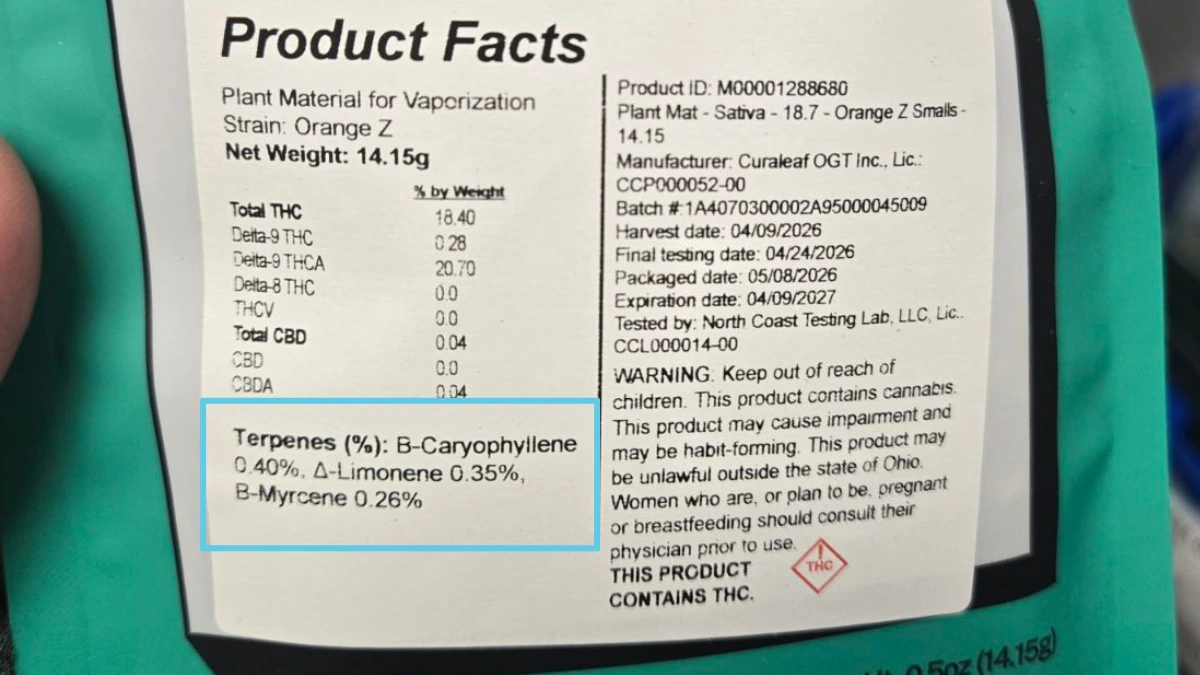
Here's how Cory typically maps desired effects to the terpenes he looks for on a product label. You can use this as a starting point before your next visit — or as a way to read a cannabis terpenes breakdown on a product you're already considering.
For relaxation or sleep: Look for myrcene and linalool. Myrcene is one of the most common terpenes in cannabis and is associated with earthy, musky aromas. Linalool, which also appears in lavender, carries a floral scent and is commonly used by people looking to wind down. Neither is a guaranteed sleep aid — cannabis affects everyone differently — but these are the terpenes budtenders consistently reach for when a customer says they want to decompress.
For focus, energy, or creativity: Limonene, pinene, and terpinolene tend to show up in products customers describe as more uplifting or clear-headed. Limonene carries bright citrus notes. Pinene smells like a forest. Terpinolene tends toward fresh, slightly floral or herbal aromas. If you're someone who avoids cannabis during the day because it makes you feel foggy, these are worth exploring.
For stress relief or physical discomfort: Caryophyllene is the terpene Cory most commonly recommends here. It has a spicy, peppery quality and is the only cannabis terpene that's also classified as a dietary cannabinoid — meaning it interacts with the body's endocannabinoid system in a way other terpenes don't. It's found in black pepper and cloves, and research suggests it may play a role in how some users experience relief from tension and discomfort.
A quick note on these categories: they're a starting framework, not a guarantee. Terpene research is ongoing, and cannabis responds differently in different people. These are the patterns budtenders observe in practice — not clinical outcomes.
Why no single terpene tells the whole story
One thing Cory is consistent about: no cannabis product has just one terpene. Every product has its own terpene profile — a particular balance of multiple compounds that work together, not in isolation.
This is why two products with identical THC levels and the same dominant terpene can still feel noticeably different. The supporting terpenes, the minor cannabinoids, and the ratio between them all contribute to the overall effect. This interaction between cannabis compounds is what's often called the entourage effect — the idea that the whole plant profile produces effects that individual compounds alone don't fully account for.
It's also why budtenders look at the full terpene breakdown on a product rather than just the top line. Dominant terpene matters. So do the ones in second and third position.
This is also a reason not to chase a single number — whether that's THC percentage or one terpene percentage — when you're trying to find the right product. The profile is the product.
How to use this before your next dispensary visit
You don't need to memorize terpene names before you walk in. But going in with a few things already considered makes the conversation faster and the recommendation better.
Think about what smells you're naturally drawn to — citrus, pine, floral, earthy. Think about the feeling you're actually after, not just "something good." Relaxation, focus, sleep, everyday stress relief — being specific helps. And if you've tried cannabis before, think about what worked and what didn't, and whether you remember anything about what you were using.
That's it. Bring those three things to the conversation, and a good budtender can take it from there. As Cory puts it: cannabis works differently for everyone, so it might take a few tries to find exactly what works — and a good budtender will be there to help you every step of the way.
If you want to dig deeper into terpenes on your own before your visit, our cannabis terpenes guide covers the full landscape.
*This article is for informational purposes only and is not medical advice. Cannabis affects individuals differently. Consult a qualified healthcare provider before using cannabis, especially if you have a medical condition, are pregnant or breastfeeding, or take prescription medications. Cannabis laws and available products vary by state — check your local regulations.
