
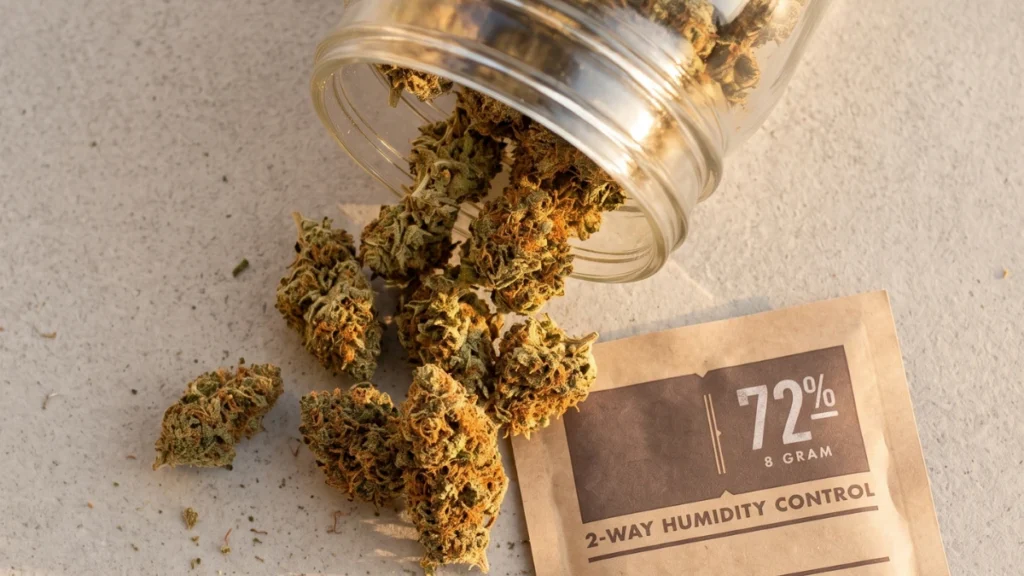
You open the jar, and it's all wrong. The bud crumbles before you've really pinched it. The stems snap instead of bending. It smells like almost nothing. And whatever it turns into when you grind it looks more like dust than flower.
Here's the good news: you can usually fix dry weed, and the fix is mostly a matter of patience. Two-way humidity packs and 48 hours will handle the large majority of cases. The DIY tricks you've read about on forums also work, but some of them carry real risk if you walk away and forget.
Quick note: this post is about flower you already bought that dried out in storage. If you're looking for information on drying and curing freshly harvested plants, that's a completely different process with different goals.
Can you rehydrate dry weed?
Yes, in most cases. Moisture is one of the few things about cannabis storage that's genuinely reversible.
Think of it this way: dryness is a moisture problem, and moisture problems have moisture solutions. You add humidity back slowly, the flower absorbs it, and the texture returns to something closer to what you bought.
What you can't reverse is degradation. If your flower is dry because it sat in a hot car for three weeks, the heat did other things to it that no amount of humidity will undo. More on how to tell the difference in a minute.
Why did my flower dry out?
Almost always, it's one of these:
- Air exposure. A jar that isn't fully sealed, or one that gets opened several times a day, loses humidity every time.
- Heat. Storage near a stove, a window, a laptop, or anywhere that gets warm speeds up moisture loss dramatically.
- Light. Direct sun does double damage — it heats the container and degrades the flower itself.
- Plastic bags. Baggies don't hold humidity, and static pulls trichomes off the bud. They're a short-term container, not storage.
- A dry room. Winter heating, dry climates, and air conditioning all pull ambient humidity down. Your flower is competing with the room.
Most dried-out flower is the result of two or three of these stacking up, not one dramatic mistake.
Is dry weed bad — and can you still smoke it?
You can smoke it. Dry flower isn't unsafe on its own.
It's just worse. Dryness makes flower burn faster and hotter, which produces harsher smoke and a thinner flavor. Terpenes — the compounds responsible for how cannabis smells and tastes — are volatile, meaning they evaporate over time, and dry flower has usually lost a good portion of them.
So rehydrating is a comfort-and-flavor project, not a safety one. The safety concerns run in the opposite direction, toward too much moisture. We'll get there.
Dry, or just old? How to tell
This is the question worth answering before you spend two days on a fix.
Dry but still good:
- Bud is brittle but holds its shape when handled gently
- Stems snap cleanly
- Aroma is faded but present when you break a piece open
- Color still looks like cannabis flower should — greens, purples, orange hairs
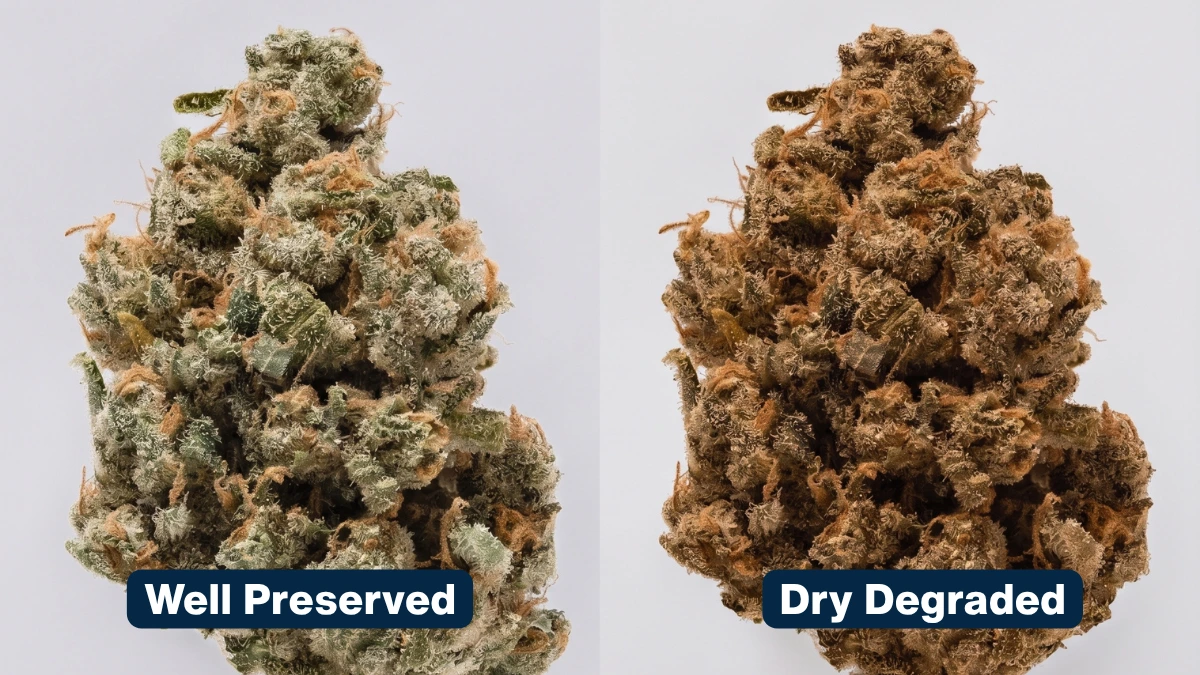
Old and degraded:
- Bud disintegrates into powder with almost no pressure
- Essentially no smell, even after breaking it up
- Color has gone brown, gray, or yellowish
- Smoke is harsh in a way that doesn't improve with a cleaner piece
Dry flower rehydrates. Old flower rehydrates into damp old flower. The moisture comes back; nothing else does.
What humidity should cannabis flower be stored at?
The commonly recommended range is 55 to 62 percent relative humidity, and it exists because both directions have consequences.
Below about 55 percent, flower gets brittle, trichomes become fragile and break off, and the smoke gets harsh. Above about 62 percent, you're moving into territory where mold and mildew can develop — and that's the failure mode you actually want to avoid, because it means throwing the whole jar out.
The range isn't a precision target. It's a band with a comfortable middle. Aiming for the middle of it is the whole strategy.
The safest way to rehydrate weed: two-way humidity packs
If you only take one thing from this post, take this one.
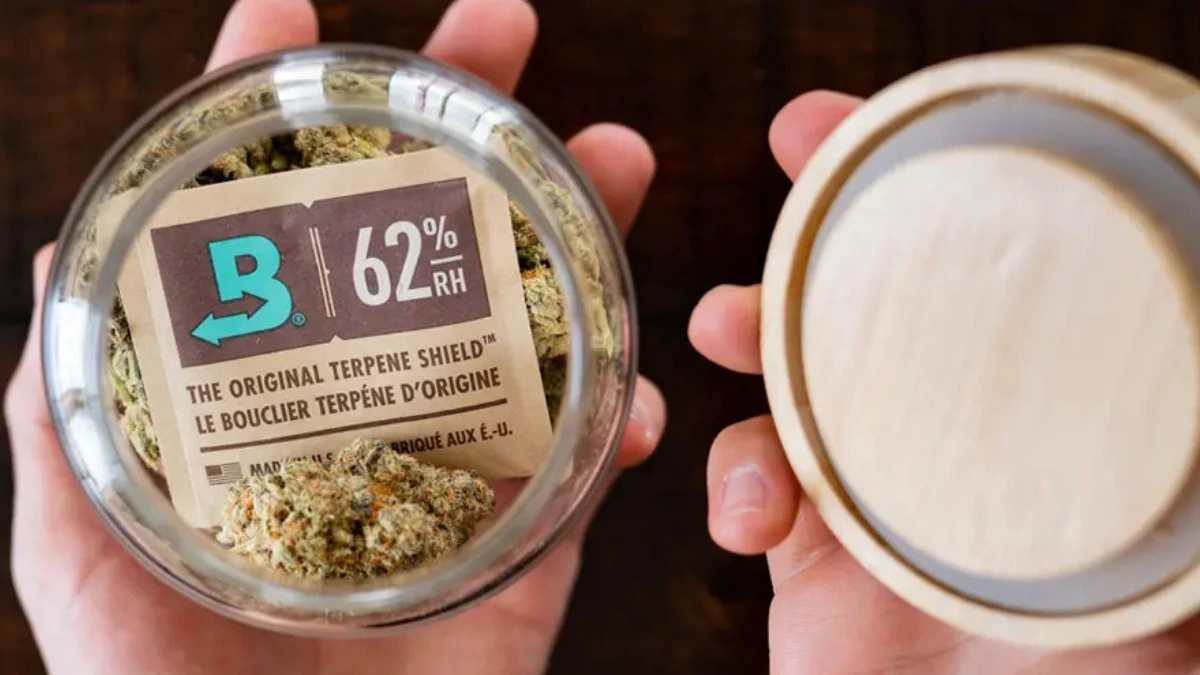
A two-way humidity pack is a small sachet that both releases and absorbs moisture. That second part is what matters. A single-direction humidifier keeps adding moisture until you remove it. A two-way pack pushes the jar toward its rated humidity and then holds it there.
Benny F., one of our budtenders, puts it plainly: "One of the safest ways is to use two-way humidity packs for 48 hours. It's safe because they're meant to regulate moisture without risking overhydration."
How to do it:
- Put the dry flower in an airtight glass jar. Don't overpack it — leave a little air.
- Drop in a two-way pack rated for your target range. Don't cut it open.
- Seal the jar and leave it somewhere cool and dark.
- Give it 48 hours. Check at 24 if you're curious, but don't keep opening it.
You'll usually feel the difference before you see it. The bud goes from snapping to giving slightly under pressure. That's the target.
DIY methods to moisten dry weed, ranked by risk
No pack on hand? These work. They also all share one requirement: you have to actually pay attention.
Benny F. again: "Some DIY methods include using a lightly damp paper towel or cotton in the jar with dry flower and even citrus peels — but make sure you're attentive and avoid direct contact so you don't over-hydrate or cause mold."
Lower risk — damp paper towel or cotton pad
Lightly dampen it, wring it out well, and place it in the jar so it doesn't touch the flower. A small piece of foil or a folded paper barrier helps. Check every few hours. This is the DIY method that goes wrong the least often.
Medium risk — bread crust or a lettuce leaf
Both carry moisture and both are food, which means both introduce bacteria and mold spores into a sealed container. If you use one, give it an hour or two at a time, not overnight, and remove it completely when you're done.
Higher risk — citrus or fruit peel
Peel holds a lot of water, and it transfers aroma. Some people like the citrus note; plenty of people find it makes their flower taste like a candle. More importantly, it's the method most likely to overshoot, because it doesn't stop giving off moisture. Short exposure, no contact, check often.
None of these are things we'd recommend over a humidity pack. They're what you do when you don't have one.
What not to do
- Don't microwave it. It doesn't rehydrate anything. It heats the flower, drives off whatever terpenes are left, and degrades cannabinoids.
- Don't use the oven. Same problem, slower.
- Don't spray it with water. Direct water on flower is how you get mold, not moisture.
- Don't seal damp flower and walk away. Nearly every mold story starts with someone setting up a DIY fix and forgetting about it for two days.
- Don't rehydrate flower you already suspect is moldy. Moisture makes that worse, not better.
How do you know if you've over-rehydrated?
Check for these:
- Spongy or squishy texture. Flower should give slightly, not compress like a marshmallow.
- Won't grind. If it gums up the grinder instead of breaking apart, there's too much water in it.
- Sour, musty, or ammonia-like smell. This is the important one. Cannabis should never smell like a damp basement.
- White, gray, or fuzzy patches. Fuzz that isn't trichomes. Trichomes look crystalline; mold looks like lint.
If you catch it early — spongy but smells fine — take the moisture source out, open the jar, and let it breathe in a dry room for a few hours.
If you see or smell anything in the last two categories, throw it out. Don't try to salvage part of the jar, don't cut off the bad section. Inhaling mold can cause respiratory irritation, and it's a genuinely bad trade for the price of an eighth.
Does rehydrating restore potency or flavor?
Partly, and it's worth being honest about which part.
What comes back: texture, smoothness, and some of the aroma. Terpenes that are still present in the flower become more perceptible when the flower isn't bone dry, so it will smell and taste better than it did.
What doesn't come back: terpenes that already evaporated, and cannabinoids that already broke down. Cannabinoids degrade over time with exposure to heat, light, and oxygen, and adding humidity doesn't rebuild them.
So: rehydrated flower will smoke better than dry flower. It won't smoke like it did the week you bought it. That's a reasonable expectation to set going in.
What if it's too dry to save?
Sometimes you open the jar and it's clearly past the point of a good smoke — no aroma, crumbles to powder, harsh no matter what you do.
That flower still has value. It's a strong candidate for cooking, because most of what makes dry flower unpleasant to smoke — the texture, the harshness — doesn't matter once it's infused into butter or oil. Dry flower is also easier to break down and work with than fresh.
The one thing you can't skip is decarboxylation — the heating step that activates cannabinoids so they're effective when eaten. Dry flower isn't already decarbed just because it's dry.
If you've never done it, our guide to cooking with cannabis walks through the whole process, including why dosing homemade edibles is harder to estimate than dosing something off a dispensary shelf.
One exception: don't cook with flower you suspect is moldy. Heat doesn't fix that either.
How to keep flower from drying out again
The short version:
- Airtight glass, not plastic bags. Fill the container reasonably full so there's less air in it.
- Cool and dark. A cabinet or drawer. Not the windowsill, not on top of the fridge, not the car.
- A humidity pack, permanently. Replace it when it goes stiff. This is the single highest-return habit here.
- Open it less. Every opening is an exchange with the room.
- Skip the fridge and freezer. Temperature swings create condensation, and frozen trichomes break off easily when handled.
For the full breakdown — container choices, how long flower actually keeps, and what to do with longer-term storage — read our complete guide to how to store cannabis.
Doing this from the start is significantly easier than rehydrating. Fixing dry weed works, but it's a repair, and repairs never quite get you back to original.
Frequently asked questions
How long do humidity packs take to rehydrate weed?
About 48 hours in a sealed glass jar. You may notice a difference sooner, but two-way packs work gradually by design, and rushing the process is what usually causes problems.
Does the orange peel trick work for dry weed?
It adds moisture, yes, but it's one of the riskier methods. Citrus peel carries a lot of water and can introduce mold if it touches the flower or stays in too long. It also transfers citrus aroma, which not everyone wants.
Can you smoke dry weed?
Yes. Dry flower isn't unsafe on its own, just less pleasant — it burns faster and hotter, which makes the smoke harsher and the flavor thinner.
Does dry weed lose THC?
Dryness by itself doesn't remove cannabinoids. What reduces potency is the exposure that caused the dryness — heat, light, and air. Adding moisture back won't reverse that.
Can you rehydrate weed with a damp paper towel?
You can, as long as the towel never touches the flower and you check the jar frequently. Use a lightly damp towel rather than a wet one, and give it short stretches of time instead of leaving it overnight.
This article is for informational purposes only and is not medical advice. Cannabis affects individuals differently. Consult a qualified healthcare provider before using cannabis, especially if you have a medical condition, are pregnant or breastfeeding, or take prescription medications. Cannabis laws and available products vary by state — check your local regulations. Do not drive or operate machinery while using cannabis. Keep cannabis products out of reach of children and pets.
