

If your usual amount stopped hitting the way it used to, a tolerance break is the most reliable fix — and it doesn't have to mean three weeks of white-knuckling. A short pause helps some people. A longer one helps more. What matters most is how you step down and how you come back.
Here's the conversation we have at the counter almost every week.
What is a cannabis tolerance break?
A tolerance break — most people say "T-break" — is a deliberate pause in cannabis use so your body becomes more sensitive to it again. That's the whole idea. You're not detoxing, cleansing, or fixing anything. You're letting a system that adapted to regular input go back toward its baseline.
Breaks range from a couple of days to a month. Longer generally does more, but the right length is the one you'll actually finish.
Why does tolerance build in the first place?
Your body has its own network for this, called the endocannabinoid system. THC works by attaching to receptors in that network — mainly one called CB1. When those receptors get activated over and over, your body responds by turning the volume down: fewer receptors available, and less response from the ones that are there.
That's tolerance. It isn't damage, and it isn't a sign you did something wrong. It's the same kind of adaptation your body makes to plenty of repeated inputs.
The encouraging part is that it reverses. In a 2012 PET imaging study published in Molecular Psychiatry, researchers scanned chronic daily cannabis smokers and found reduced CB1 receptor density that was selective to certain cortical brain regions — and after roughly four weeks of monitored abstinence, receptor density had returned to normal levels. A later study from a Yale-led team, published in Biological Psychiatry: Cognitive Neuroscience and Neuroimaging, found that the gap between dependent users and non-users was no longer detectable after just two days without cannabis, and was still absent at 28 days. clinicaltrialsPhuket Island Rehab
Two days is not a full reset. But it suggests the earliest movement happens faster than most people assume.
If you want the fuller picture of how that system works, our endocannabinoid system guide walks through it.
Is it really tolerance — or something else?
Before you commit to a break, rule out the boring explanations. We see all four of these regularly:
- The product changed. Different batch, different brand, different harvest. A ten-point swing in THC percentage is common and completely normal.
- You switched formats. Concentrates, vapes, flower, and edibles all deliver differently. Moving between them changes the experience even when your tolerance hasn't moved at all.
- It's duration, not intensity. Plenty of people describe a "weaker" high when what actually changed is how long it lasts. That's a different variable — our pillar on how long a cannabis high lasts breaks down what drives it.
- Your expectations drifted. The first few times are novel. Novelty fades even when the effect doesn't.
If you've checked all four and several different products still feel flat, tolerance is the likely answer.
How long should a tolerance break be?
There's no single correct number, so think in tiers.
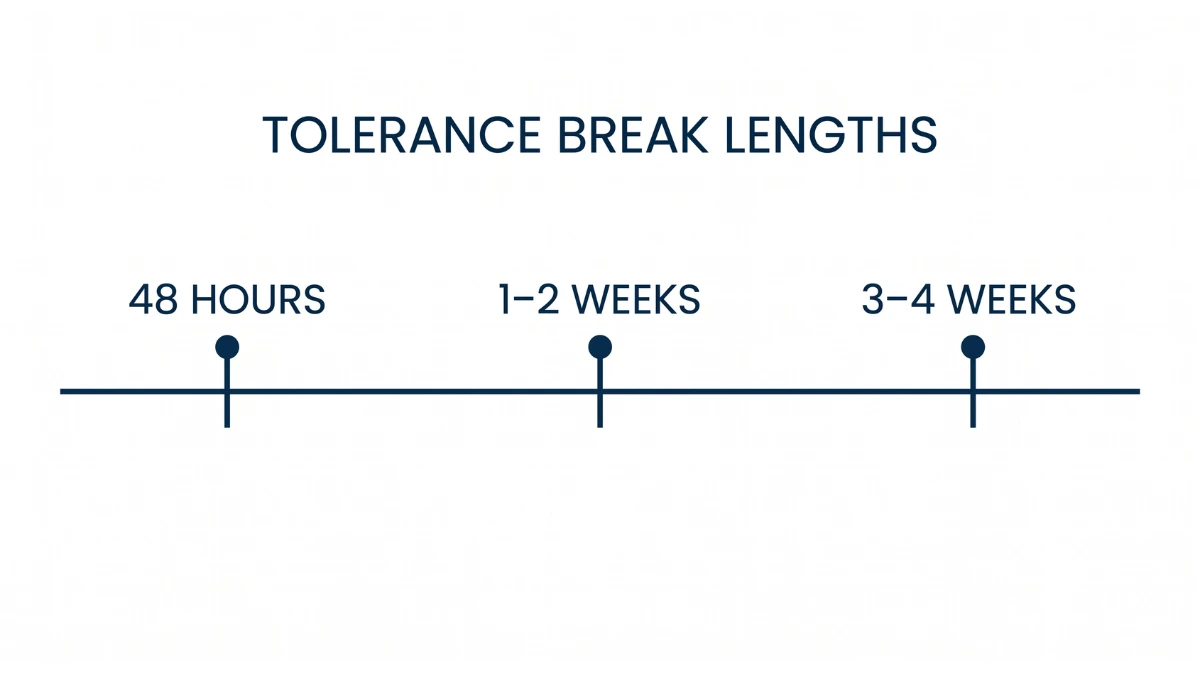
48 hours to a few days. The most realistic option for most people. Not a full reset, but the early receptor changes appear to start here, and many regulars tell us their next session lands noticeably harder.
One to two weeks. A meaningful middle ground. This is where people most often report that a normal amount feels like a normal amount again.
Three to four weeks. The closest thing to a full reset. Ryan F., one of our budtenders, puts the practical target around 21 days; the imaging research points closer to 28. Either way, you're in the range where the research suggests receptor availability has largely normalized.
Worth separating two things that get blurred constantly: how long THC and its byproducts stay detectable in your body is a different question from how long your receptors take to adjust. Clearance timelines vary enormously depending on how often you use, what you use, and your individual body. Don't treat the numbers above as a guide to passing anything.
Should you taper down or stop cold?
This is the single most useful thing we tell people, and it comes straight from Ryan F.:
"If you decide to take a break, we recommend gradually decreasing the amount of cannabis you consume. Give your body a more natural path to winding down."
Tapering tends to make the first few days easier. Cutting your usual amount roughly in half for a few days, then halving it again, gives your system a ramp instead of a cliff. Some people prefer to stop outright and get it over with — that works too, especially for shorter breaks. Neither approach is more virtuous than the other.
If you taper, set the schedule before you start. Deciding day by day is how a taper quietly turns into "not really a break."
What does the first week usually feel like?
Some people feel nothing at all. Others notice a rough patch in the first several days. Commonly reported: irritability, trouble falling asleep, vivid dreams, lower appetite, and cravings around your usual times of day.
Two things make this easier to sit with. First, these effects typically peak early and ease as the week goes on. Second, the timing of your cravings is often about routine as much as anything else — the 9 p.m. habit is a habit.
If cutting back feels significantly harder than you expected, or the sleep and mood effects stick around, that's worth raising with a healthcare provider. It's a normal thing to ask about.
What our budtenders suggest during a break
- Keep a two-line log. Date and one sentence on how you slept and felt. You'll want the record when you're deciding how to restart.
- Replace the ritual, not the substance. Most of what people miss is the wind-down, not the THC. A walk, tea, a shower — something that occupies the same slot in your evening.
- Don't swap formats and call it a break. Moving from flower to edibles or high-THC vapes isn't a pause; tolerance lives at the receptor level and carries across formats.
- Pick a low-demand stretch. Starting a break during a stressful work week stacks the deck against you.
How do you come back without spiking right back up?
Restart lower than feels necessary. Genuinely lower.
Take one small amount, then wait — a full two hours if you're using an edible, at least twenty minutes with inhaled products. Use one format for the first week rather than mixing. And avoid returning to your pre-break amount on night one, which is the fastest way to undo what you just spent weeks building.
If you're interested in staying at the lower end deliberately, our guide to microdosing cannabis covers how people approach that.
Mistakes we see regulars make
Setting the bar at "like my first time." A break restores sensitivity. It doesn't restore novelty. People who expect the latter usually decide the break "didn't work."
Starting on the worst possible week. Deadlines, travel, family stress — pick a calmer stretch.
Going straight back to the old amount. The most common way a successful three-week break gets erased in one evening.
Treating it as all-or-nothing. A break you shortened to four days still did something. A break you abandoned on day two and restarted next month is fine. This isn't a test.
Frequently asked questions
Does a 48-hour tolerance break actually do anything?
Two days won't fully reset anything, but the research suggests the earliest changes in receptor availability show up fast, and plenty of regulars report a stronger next session. It's a reasonable starting point if a longer break isn't realistic.
Will CBD break my tolerance break?
CBD doesn't bind to CB1 receptors the way THC does, so it isn't working against the part of the system you're targeting. That said, many CBD products contain small amounts of THC. For a clean reset, pause everything and keep the variables low.
Do edibles have a separate tolerance from flower?
Not really. Tolerance builds at the receptor level, so it carries across formats. What differs is absorption and duration, which is why switching to edibles can temporarily feel like the tolerance vanished. It usually hasn't.
Does tolerance come back faster the second time?
For most people it rebuilds at the pace of their habits, not on some accelerated clock. The bigger factor is how you restart — going straight back to your old amount rebuilds it quickly.
How do I know if it's tolerance or just a weaker product?
Check the simple explanations first: THC percentage, brand, batch, format. If several different products in a row all feel flat, tolerance is the likelier answer.
The short version
Tolerance building is normal and reversible. Rule out the boring explanations first. If you're taking a break, taper rather than quitting cold, pick a length you'll actually finish, and restart lower than you think you need to. If you want help thinking through where to restart, ask a budtender — it's a question we get constantly, and there's nothing embarrassing about it.
This article is for informational purposes only and is not medical advice. Cannabis affects individuals differently. Consult a qualified healthcare provider before using cannabis, especially if you have a medical condition, are pregnant or breastfeeding, or take prescription medications. Cannabis laws and available products vary by state — check your local regulations. Do not drive or operate machinery while using cannabis. Keep cannabis products out of reach of children and pets.
