
If you've spent any time in front of an edibles display case, you already know the format options have multiplied fast. Gummies, chocolates, hard candies, capsules, THC-infused drinks, lozenges, tinctures — the category has quietly become one of the most diverse sections in any dispensary.
So which formats are people actually gravitating toward? We pulled our customer purchase data from March through May 2026 to find out. The answer is less of a horse race than you might expect — and more useful for figuring out where you fit.
Budtender Ryan puts it plainly: "Most customers go for edibles because the large variety allows them to find something very specific to their needs at different flavors as well — it's enjoyable and discreet at the same time."
That variety is real. But the data shows customers aren't spreading their choices evenly across it.
The numbers: what edible formats people are actually buying
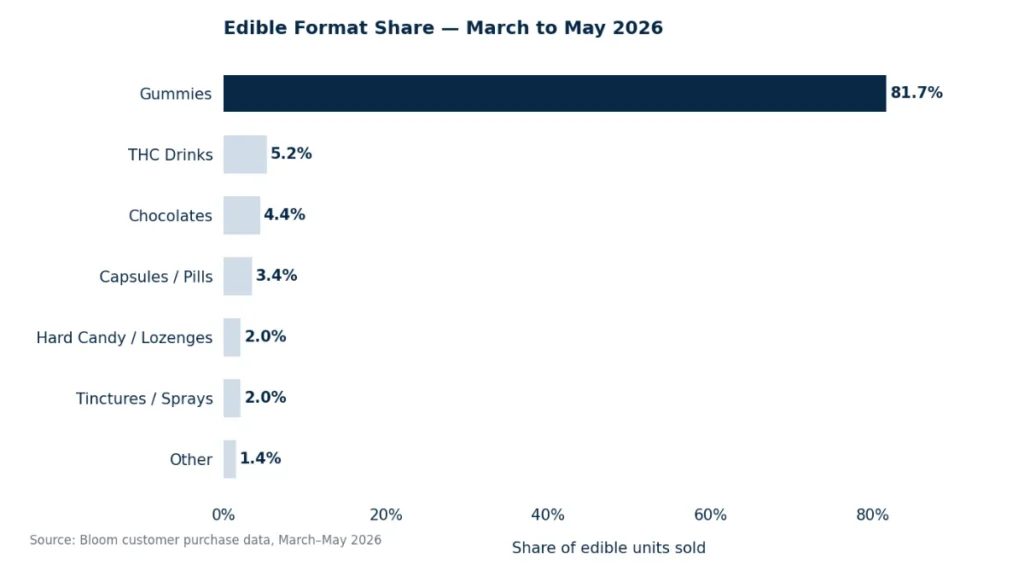
Across more than 136,000 edible units sold between March and May 2026, one format wasn't just winning — it was lapping the field.
Gummies accounted for 81.7% of all edible units sold — roughly 16 out of every 20 edible purchases. Every other format combined made up the remaining 18.3%.
The mid-tier shook out like this:
- THC drinks and mixes: 5.2%
- Chocolates and caramels: 4.4%
- Capsules and pills: 3.4%
- Hard candy, lozenges, and mints: 2.0%
- Tinctures and sprays: 2.0%
- Baked goods, infused honey, and miscellaneous: under 1.5% combined
The story isn't that gummies are popular. It's that they've already won the format conversation — and the more interesting question is what's happening in the formats behind them.
Why gummies dominate (it's not just the taste)
Taste matters, but format preference rarely comes down to flavor alone. Our budtenders consistently hear a few reasons that come up over and over when customers explain why they defaulted to gummies.
Pre-dosed precision. Most gummies come in clearly labeled 2.5mg, 5mg, or 10mg units. For newer consumers especially, that makes it easy to start low, track what you took, and adjust next time without guessing.
Wide mg range in one SKU. A single gummy product line might span from 2.5mg to 25mg per piece — sometimes higher. That range lets the same customer come back at different life stages, stress levels, or tolerance points without switching brands.
Familiar format. A gummy looks and functions like something people have been eating since childhood. There's no new ritual to learn, no equipment, no preparation. You take one and you're done.
Shelf life and portability. Gummies hold up well over time and travel easily. They don't melt in a warm car the way chocolate can, and they don't require refrigeration the way some drinks do.
Discretion. A gummy in a small container looks like any other supplement. For people who use cannabis at work, while traveling, or around family members who don't need to know, that matters.
None of this means gummies are the right choice for every person or every situation. But these are real functional advantages that explain why the format has captured such a commanding share of the edible market — not just at Bloom, but across the industry.
Want the full picture on what to look for when choosing edibles? Our guide to cannabis edibles covers onset times, dosing fundamentals, and how different formats metabolize.
The case for THC drinks: a format on the rise
At 5.2% of edible units sold, THC drinks are a distant second in raw volume. But the format is punching above its share in terms of cultural momentum — and there are real reasons it's attracting attention.
The appeal of THC drinks is largely situational. They fit naturally into social contexts where alcohol would otherwise be the default: a gathering, a dinner, a night where you want to feel something without drinking. The experience of sipping a beverage is familiar in a way that's distinct from taking a gummy and waiting.
Some THC drink formulations also use nano-emulsified cannabinoids, which may produce a faster onset than traditional edibles — sometimes closer to 15–30 minutes rather than 45–90. That faster feedback loop is meaningful for anyone who's ever misjudged an edible dose because they couldn't tell if it was working yet. (Individual results vary, and onset depends on the specific product formulation, not the drink format alone.)
The tradeoffs are real: drinks tend to cost more per milligram than gummies, availability varies by market, and they require more careful storage. But for the right use case — social settings, alcohol replacement, or anyone who prefers drinking to chewing — they're worth understanding.
For a deeper look at how THC drinks work and what to look for on the label, our full guide to THC drinks is worth a read before your next dispensary visit.
Chocolates and hard candy: the slow-and-steady formats
Chocolates and caramels (4.4%) and hard candy, lozenges, and mints (2.0%) occupy a quieter corner of the edible market — but they have a loyal following for good reasons.
Chocolates appeal to people who want a more traditional edible experience. The ritual of breaking off a square, the flavor, the slower eating pace — it's a different kind of consumption than pulling a gummy from a jar. The tradeoff is practical: chocolate is temperature-sensitive, which complicates storage and portability in warmer months.
Hard candy and lozenges are worth distinguishing from each other. Hard candy is swallowed as it dissolves, following the same metabolic path as other edibles — liver processing, slower onset. Lozenges and sublingual mints, by contrast, are designed to dissolve under the tongue or against the cheek, where cannabinoids can absorb directly into the bloodstream. That means a potentially faster, different-feeling onset. If a product's packaging specifies sublingual use, that distinction matters when you're setting expectations for timing.
How to choose the right edible format for you
The data tells you what most people are buying. It doesn't tell you what's right for your situation. Here's a simple way to think through it:
If you want predictable dosing and easy adjustability → Gummies. Pre-dosed units, wide mg range, easy to split or stack.
If you want a social-setting alternative to alcohol, or faster onset → THC drinks. Best for sipping occasions; check the formulation for nano-emulsification if onset speed matters to you.
If you want a familiar ritual and don't mind slower onset → Chocolates or hard candy. Good for home use; store carefully if you live somewhere warm.
If you want maximum discretion and consistency → Capsules or pills. They look like any other supplement, have no flavor, and deliver a consistent dose every time. Popular among people who use cannabis on a regular schedule.
If you want precise control over onset and duration → Sublingual lozenges or tinctures. A smaller share of the market (2.0% each), but a deliberate choice for people who've done the research and know what they want.
The best edible format is the one that fits your lifestyle, your tolerance, and your goals for the experience. If you're not sure where to start, the most useful thing you can do is talk to a budtender before you buy — they can help you narrow it down based on what you're actually looking for.
In states where cannabis is legal, a licensed dispensary is the right place to ask those questions. Our guide to cannabis edibles is also a good place to ground yourself before your next visit.
This article is for informational purposes only and is not medical advice. Cannabis affects individuals differently. Consult a qualified healthcare provider before using cannabis, especially if you have a medical condition, are pregnant or breastfeeding, or take prescription medications. Cannabis laws and available products vary by state — check your local regulations. Do not drive or operate machinery while using cannabis. Keep cannabis products out of reach of children and pets.
