

Summer is road-trip and airport season, and a question comes up at our counter every June: "Can I just bring this with me?" It's a fair thing to ask. Cannabis is legal in more places than ever, the headlines in 2026 have been confusing, and packing a familiar product feels easier than figuring out the rules at your destination.
Here's the short version: traveling with cannabis is trickier than it looks, and most of the rules that trip people up haven't actually changed. Below is what's true right now, why it works that way, and the lower-stress way to handle a trip.
Can you travel across state lines with cannabis?
Not legally — even between two states where cannabis is legal.
This surprises people, so it's worth explaining the why. State legalization stops at the state line. The moment cannabis crosses from one state into another, you've entered federal territory, and cannabis is still largely illegal under federal law. That's true whether you're driving from one legal state to a neighboring legal state, or flying between two of them. The trip itself is the problem, not where you start or finish.
So a product you bought legally at home doesn't become legal to carry somewhere else. The purchase was fine; the transport is the issue.
Did the 2026 rescheduling change the travel rules?
This is where a lot of the confusion comes from, so let's clear it up.
In April 2026, the federal government moved certain cannabis into a lower-risk category. FDA-approved cannabis medications and state-licensed medical cannabis were reclassified from Schedule I to Schedule III under federal law (Federal Register, April 2026). A broader review of whether all cannabis should be reclassified is underway, with a federal hearing scheduled to begin at the end of June 2026.
That's a real shift, and it's been front-page news. But here's what it didn't do: it didn't legalize cannabis at the federal level, it didn't change the rules for adult-use (recreational) products, which remain in the stricter category, and — most relevant for travel — it didn't make it legal to carry cannabis across state lines or through an airport. The thing that changed is how some products are classified, not whether you can travel with them.
If you've seen a post claiming "you can fly with it now," that's the misread we hear most. The travel rules are essentially where they were.
What happens if you fly with cannabis?
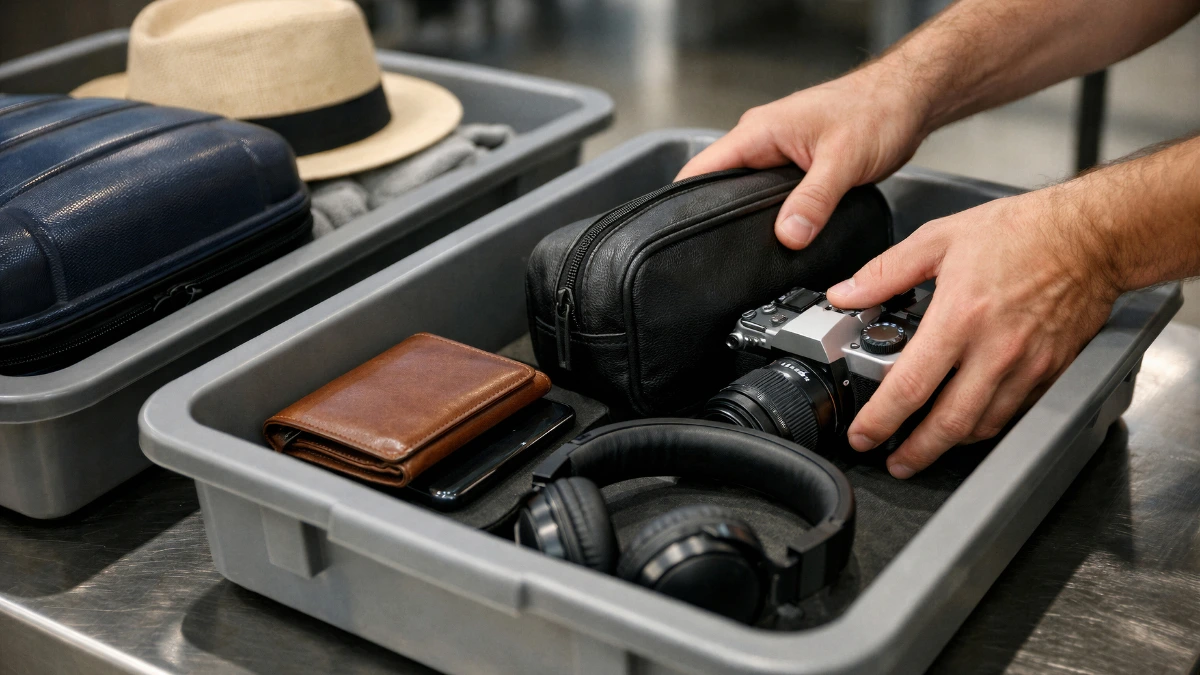
Airports and airplanes run on federal rules, so once you're past the security checkpoint, state legality doesn't apply.
The TSA's own guidance is that its officers are looking for threats to flight safety — weapons, explosives — not drugs, and they don't actively search for cannabis (TSA). But if cannabis turns up while they're screening your bag for something else, they're required to refer it to law enforcement. What happens after that depends entirely on where you are. In a legal state, local police might just have you toss it or walk away. In a state where it's illegal, the same situation can mean a citation, a missed flight, or worse.
International travel is a harder line. U.S. Customs and Border Protection enforces federal law at every port of entry, including airports, and crossing the border with cannabis — in either direction, for any reason — can lead to seizure, fines, or penalties regardless of what's legal where you came from (U.S. Customs and Border Protection). For non-citizens, it can also affect their ability to enter the country. There's no version of flying internationally with cannabis that's worth the risk.
What about road trips and driving?
A car doesn't change the math. Driving cannabis across a state line is the same federal issue as flying with it, even on a quick hop between two legal states.
Within a single legal state, transporting a legally purchased product is usually allowed, but the details vary — many states have "open container"-style rules about keeping cannabis sealed and out of reach while you drive. And one rule has no gray area anywhere: never drive after using cannabis. It can affect reaction time and judgment, and driving under the influence is illegal in every state.
Before any trip, it's worth reading up on the rules where you live and where you're going. If that's our neck of the woods, we keep plain-English rundowns here: Ohio cannabis laws and Maryland cannabis laws. If you'll be behind the wheel, the impaired-driving rules are worth a separate look — Ohio DUI laws and Maryland DUI laws.
Can you bring CBD or hemp products instead?
Sometimes — but read the label carefully.
Hemp-derived CBD that contains less than 0.3% delta-9 THC is treated differently from cannabis for the purpose of flying, and is generally allowed. The catch is that gummies, oils, and vape cartridges often look identical whether they're hemp-derived or not, and a label alone may not settle the question in real time. If you're traveling with a hemp or CBD product, keep it in its original packaging, and consider carrying the product's lab report (often called a Certificate of Analysis) that shows the THC level. It won't be checked every time, but it can shorten the conversation if anyone asks.
When in doubt, the safest rule is simple: if you'd be upset to have it confiscated, leave it home.
The simpler move: buy legal when you arrive
Here's the approach we usually point people to. If cannabis is legal where you're headed, you don't need to travel with anything at all — a licensed dispensary at your destination can set you up once you're there.
It's lower-stress in every way. You skip the legal gray zone of transport entirely, you get products that are tested and labeled for that market, and you can ask a budtender what works for the occasion. Just check the local possession limits before you go, since how much you can buy and carry varies by state — for our states, that's covered in the Ohio possession limits and Maryland possession limits guides.
A little planning up front means you spend your trip actually enjoying it, not worrying about what's in your bag.
Frequently asked questions
Can I fly with edibles or gummies? Once you pass airport security, you're under federal rules, and edibles are treated the same as flower for that purpose. TSA officers don't search for them, but anything found is referred to local police, and the outcome depends on the airport's jurisdiction. Hemp-derived products under 0.3% delta-9 THC are a separate category, but they often look identical to cannabis edibles, which can still prompt questions.
Does a medical marijuana card let me travel with cannabis across state lines? No. A medical card is issued under one state's program and doesn't authorize you to carry cannabis into or through another state. Crossing state lines is governed by federal law, which a state-issued card can't override. Check the rules in both your home state and your destination.
Can I mail cannabis to myself when I travel? Mailing cannabis or shipping it across state lines is prohibited under federal law, even between two states where it's legal. It isn't a workaround for travel.
Is it safer to just buy cannabis at my destination? If cannabis is legal where you're going, buying from a licensed dispensary after you arrive avoids the legal gray zone of transporting it. Check the local possession limits first, since they vary by state, and never drive after using.
This article is for informational purposes only and is not medical advice. Cannabis affects individuals differently. Consult a qualified healthcare provider before using cannabis, especially if you have a medical condition, are pregnant or breastfeeding, or take prescription medications. Cannabis laws and available products vary by state — check your local regulations. Do not drive or operate machinery while using cannabis. Keep cannabis products out of reach of children and pets.
